
Age & Liver Spot Treatment in
Marietta & East Cobb
Board-certified dermatology care for solar lentigines, sun spots, and age-related hyperpigmentation – with proven treatments to restore even, healthy-looking skin.
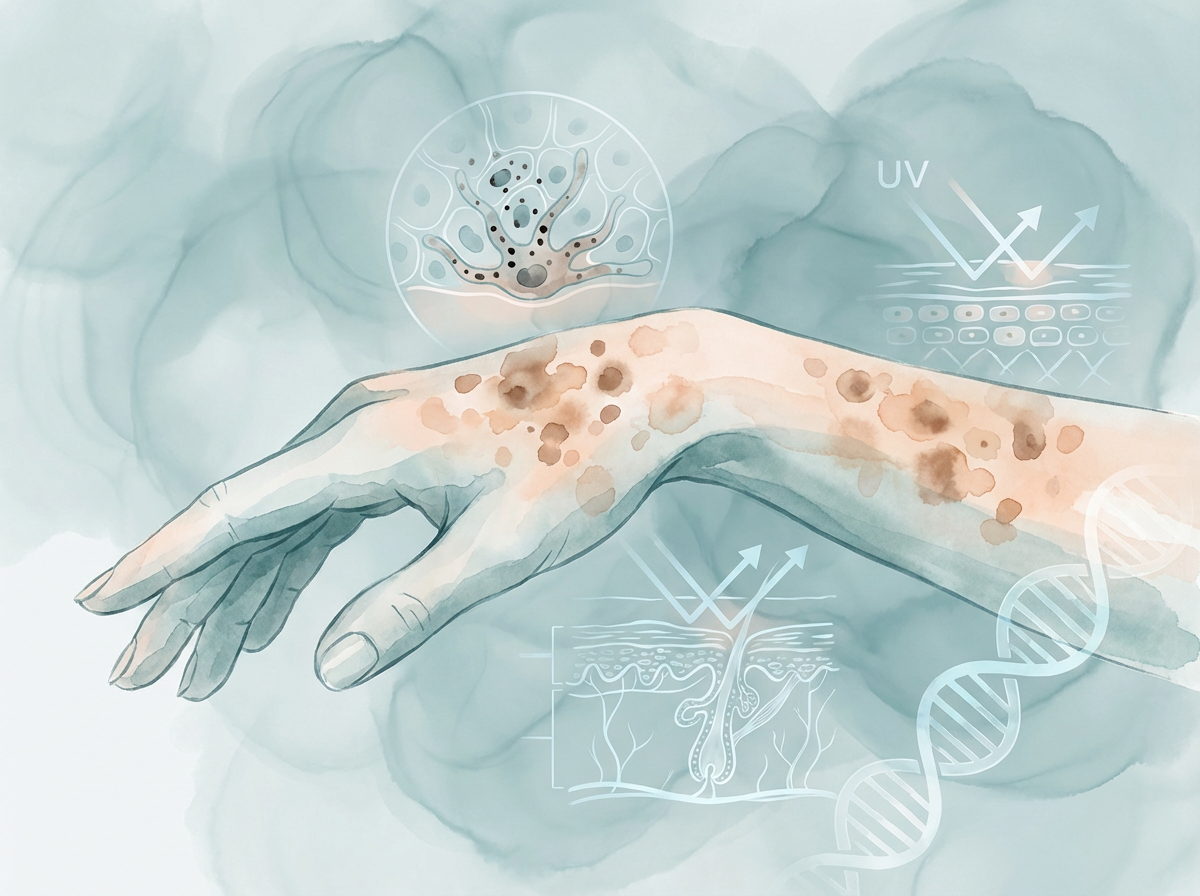
What Are Age & Liver Spots?
Age spots – clinically known as solar lentigines – are flat, brown or dark patches that develop on areas of skin with the most sun exposure. They are one of the most common reasons patients visit a dermatologist for cosmetic concerns.
While age spots are benign, they signal cumulative UV damage to the skin. This matters because the same sun exposure that causes hyperpigmentation also increases the risk of skin cancer. A dermatologist evaluation ensures that what looks like a harmless spot isn't something more serious.
At DESSNA, we combine thorough diagnostic evaluation with advanced treatment options – so you get peace of mind and visibly clearer, more even skin.
Not all dark spots are the same
Solar Lentigines (Sun Spots)
Flat, tan-to-dark-brown spots caused by cumulative UV exposure. Most common on the face, hands, shoulders, and arms.
Liver Spots (Age Spots)
A common term for solar lentigines that appear with age. Despite the name, they are unrelated to liver function.
Seborrheic Keratoses
Raised, waxy, brown growths that can resemble age spots but are a separate benign condition requiring different treatment.
Lentigo Maligna (Precancerous)
A type of melanoma in situ that can mimic an age spot. Professional evaluation is essential to distinguish benign from concerning lesions.
Why Age Spots Develop
Age spots are the visible result of cumulative skin damage. Understanding the contributing factors helps guide both treatment and long-term prevention.
Cumulative UV Exposure
Years of sun exposure accelerate melanin production in localized areas. UV radiation damages melanocytes, causing them to produce pigment unevenly – resulting in concentrated dark patches.
Natural Aging Process
As skin ages, melanocyte distribution becomes less uniform. Combined with thinner skin and slower cell turnover, pigment irregularities become more visible over time.
Genetics & Skin Type
Fair-skinned individuals are more susceptible to solar lentigines, though age spots can develop in all skin types. Family history of sun sensitivity increases risk.
Hormones & Medications
Certain medications (including some antibiotics and diuretics) can increase photosensitivity. Hormonal changes may also influence how the skin responds to UV exposure.
How We Treat Age Spots at DESSNA
We prioritize accurate diagnosis first, effective treatment second, and long-term prevention always – so your results are safe, lasting, and visible.
Diagnostic Evaluation
Your dermatologist performs a thorough skin examination using dermoscopy to assess each spot's structure, borders, and pigment pattern. This critical first step distinguishes benign age spots from potentially concerning lesions like lentigo maligna or early melanoma.
Targeted Treatment Plan
Based on your evaluation, we recommend the most effective approach for your skin type, spot characteristics, and goals. Options range from prescription lightening agents and chemical peels to laser therapy and cryotherapy – selected for safety and results.
Prevention & Maintenance
Fading existing spots is only part of the plan. We build a sun protection and maintenance strategy to prevent new spots from forming, protect treatment results, and support long-term skin health – including annual skin checks.
Age Spot Treatment Options at Our Marietta Practice
Your treatment plan is tailored to your skin type, the number and depth of spots, and your aesthetic goals. Here are the tools we use to restore even skin tone.
BBL Photofacial
BroadBand Light therapy targets melanin in age spots, breaking up pigment while stimulating collagen renewal. Effective for treating multiple spots across larger areas like the face, chest, and hands.
Laser Skin Resurfacing
Fractional laser technology precisely targets pigmented cells while promoting new, evenly toned skin growth. Options include ablative and non-ablative approaches based on your skin type and downtime preferences.
Chemical Peels
Medical-grade peels accelerate cell turnover to fade superficial pigmentation while improving overall skin texture, tone, and radiance. Multiple peel depths available based on severity.
Prescription Lightening Agents
Targeted topical treatments including hydroquinone, retinoids, azelaic acid, and vitamin C formulations that inhibit melanin production and gradually fade existing spots over 8 – 12 weeks.
Cryotherapy
Controlled application of liquid nitrogen destroys excess pigment in individual spots. Best suited for a small number of clearly defined lesions. Minimal downtime with predictable results.
Sun Protection Planning
Comprehensive UV protection strategy including medical-grade sunscreen recommendations, protective habits, and antioxidant support to prevent new spot formation and protect treatment results.
When Is a Dark Spot More Than an Age Spot?
Most age spots are harmless. But certain features can indicate a precancerous or cancerous lesion. The ABCDEs of melanoma detection apply:
One half doesn't match the other
Irregular, ragged, or blurred edges
Multiple shades or uneven color
Larger than 6mm (pencil eraser)
Changing in size, shape, or color
Why Professional Evaluation Is Essential
Age Spots vs. Melanoma
Lentigo maligna – a form of melanoma in situ – can closely resemble a benign age spot to the untrained eye. Dermoscopic evaluation by a board-certified dermatologist reveals structural details invisible to the naked eye, enabling early detection when treatment is most effective.
Age Spots vs. Seborrheic Keratoses
Seborrheic keratoses are raised, waxy growths that are also benign but require different treatment approaches. Distinguishing between these conditions ensures you receive the right intervention – not a one-size-fits-all approach.
If you have spots that are new, changing, or look different from others on your skin, a dermatologist evaluation is the safest first step – and it takes just minutes.
What Our Patients Say
“Doctor Edward Chen is the BEST! He's very professional, very caring, he will always give you his honest advice. He helped my son who had acne issues – his skin now looks great like never before.”
“Dr. Candace Green has a very warm bedside manner and makes you feel very comfortable! Great office, staff, and overall experience.”
“The office is well run and Dr. Green is thorough.”
Age & Liver Spot Treatment FAQs
Answers to the questions our Marietta and East Cobb patients ask most about age spot care.
The vast majority of age spots (solar lentigines) are completely benign and pose no health risk. However, some lesions that look like age spots can be precancerous or cancerous – including lentigo maligna, a form of melanoma in situ. A dermatologist evaluation with dermoscopy is the most reliable way to confirm that a spot is truly benign.
Ready for Clearer, More Even Skin in Marietta or East Cobb?
Your first step is a skin evaluation with one of our board-certified dermatologists. We'll examine your spots, confirm the diagnosis, and recommend the most effective treatment for your skin type and goals.
Most patients see visible improvement within 2 – 4 weeks of in-office treatment.
Related Conditions & Services
Explore other pigmentation and skin discoloration conditions we treat at our Marietta practice