
Lipoma & Cyst Removal in
Marietta & East Cobb
Board-certified surgical dermatology care for the safe, complete removal of lipomas and cysts – with expert technique to minimize scarring, prevent recurrence, and restore smooth, comfortable skin.
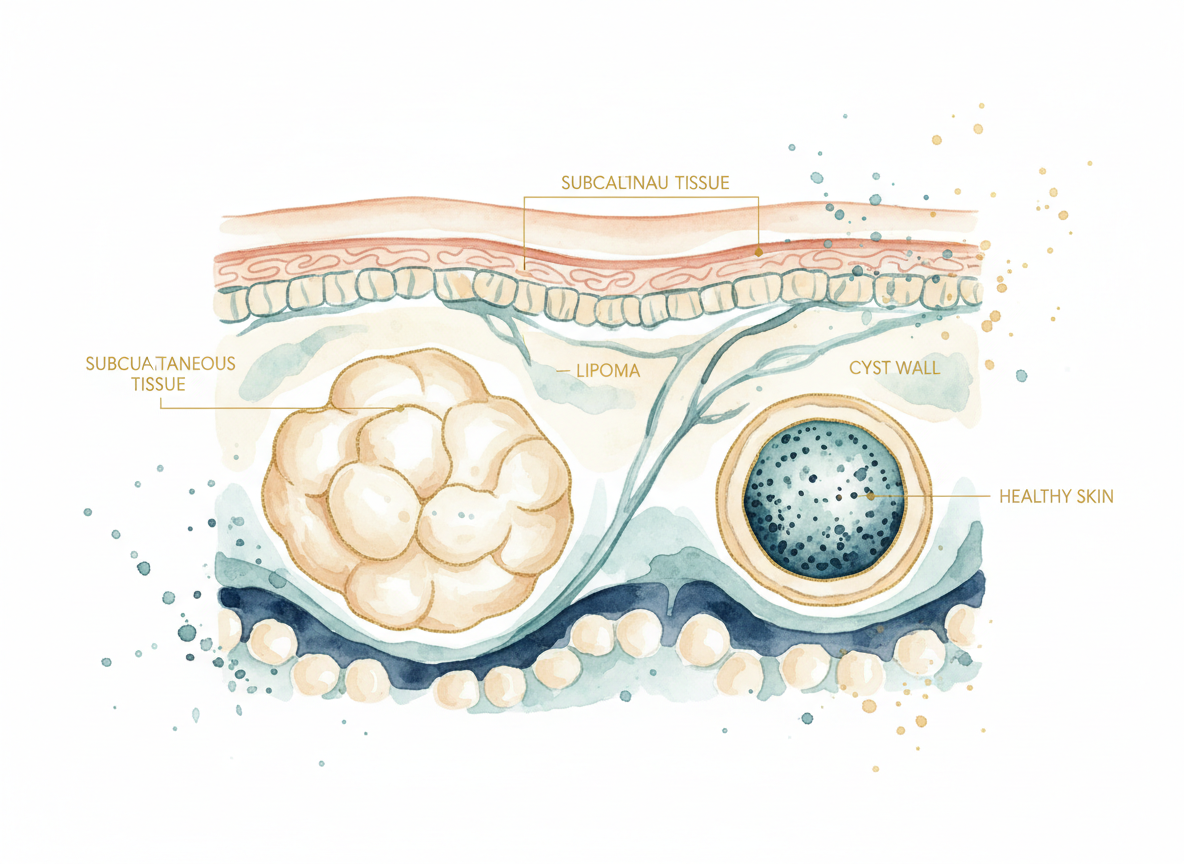
What Are Lipomas & Cysts?
Lipomas and cysts are among the most common benign growths that develop beneath the skin. While both present as lumps or bumps, they are fundamentally different – lipomas are composed of fat cells, while cysts are fluid- or keratin-filled sacs lined with epithelial tissue.
Most lipomas and cysts are harmless and grow slowly over months to years. However, they can become painful if they press on nerves, become infected, or grow large enough to interfere with movement or appearance. In rare cases, a lump that appears to be a lipoma may actually be a liposarcoma (malignant fatty tumor), which is why professional evaluation is important.
At DESSNA, we evaluate every subcutaneous lump with clinical expertise, confirm the diagnosis, and perform complete surgical excision when removal is indicated – with meticulous technique to minimize scarring and prevent recurrence.
Types of growths we remove
Epidermal Inclusion Cyst (Sebaceous Cyst)
The most common type of skin cyst. A sac filled with keratin (not sebum, despite the common name) that develops from a blocked hair follicle or skin trauma. Presents as a firm, round, movable nodule with a central punctum.
Pilar Cyst (Trichilemmal Cyst)
Develops from the outer root sheath of hair follicles, most commonly on the scalp. Smooth, firm, and mobile with a thicker wall than epidermal cysts. Often runs in families and may occur in multiples.
Lipoma
A benign tumor composed of mature fat cells (adipocytes) enclosed in a thin fibrous capsule. Soft, doughy, and mobile beneath the skin. Typically painless and slow-growing, ranging from 1 cm to over 10 cm in diameter.
Dermoid Cyst
A congenital cyst containing skin elements including hair follicles, sweat glands, and sebaceous glands. Most commonly found near the eyebrows, scalp, or midline of the body. Requires complete excision to prevent recurrence.
Why Lipomas & Cysts Develop
Lipomas and cysts arise from different mechanisms, but both are common, usually benign, and treatable. Understanding the cause helps guide the most effective removal approach.
Blocked Follicles & Skin Trauma
Epidermal cysts develop when a hair follicle becomes blocked or when skin cells are pushed deeper during an injury. The trapped cells continue producing keratin, forming a slowly expanding sac beneath the skin surface.
Fat Cell Overgrowth
Lipomas form when fat cells within the subcutaneous tissue multiply abnormally, creating a well-encapsulated, soft mass. The exact trigger is unknown, but genetic predisposition plays a significant role – lipomas often run in families.
Genetic Predisposition
Familial multiple lipomatosis is an inherited condition causing multiple lipomas. Pilar cysts also have a strong genetic component. A family history of either condition significantly increases your likelihood of developing them.
Infection & Inflammation
Cysts can become inflamed or infected when bacteria enter through the central punctum or when the cyst wall ruptures internally. This causes sudden pain, redness, swelling, and sometimes drainage – requiring prompt treatment.
How We Remove Lipomas & Cysts at DESSNA
We combine diagnostic precision with surgical expertise – confirming the nature of the growth, performing complete removal, and delivering results you can feel confident about.
Clinical Evaluation & Diagnosis
Your dermatologist examines the lump's size, depth, mobility, and characteristics to determine whether it is a lipoma, cyst, or another type of subcutaneous growth. In some cases, ultrasound imaging may be recommended to assess the lesion's depth and relationship to surrounding structures before planning excision.
Surgical Excision
Under local anesthesia, we perform a complete excision – removing the entire cyst wall or lipoma capsule to prevent recurrence. The incision is planned along natural skin tension lines for optimal cosmetic results. All excised tissue is sent to pathology for microscopic analysis to confirm the diagnosis.
Closure, Pathology & Aftercare
Multi-layer closure with fine sutures minimizes scarring and promotes optimal healing. We provide detailed wound care instructions and schedule follow-up to monitor healing, review pathology results, and remove sutures. Scar optimization guidance is included to ensure the best long-term cosmetic outcome.
Lipoma & Cyst Removal Options at Our Marietta Practice
Your removal technique is selected based on the type, size, depth, and location of the growth, as well as whether it is currently inflamed or infected. Here are the surgical tools we use.
Elliptical Excision
The gold standard for complete removal. An elliptical incision is made over the growth, the entire lipoma capsule or cyst wall is dissected free, and the wound is closed in layers with fine sutures. Provides the lowest recurrence rate and a definitive pathological diagnosis.
Minimal Incision Extraction
A smaller incision is made and the lipoma is expressed through the opening using manual pressure and blunt dissection. Produces a shorter scar than standard excision while still achieving complete removal for appropriately sized lipomas.
Cyst Excision with Wall Removal
Complete removal of the cyst including its entire wall (capsule) is essential to prevent recurrence. We carefully dissect the cyst free from surrounding tissue, preserving the wall intact whenever possible. Ruptured or previously inflamed cysts may require a wider excision.
Incision & Drainage (Infected Cysts)
When a cyst is actively infected with surrounding cellulitis, we first drain the infection and prescribe antibiotics. Definitive excision is then performed 4 – 6 weeks later once inflammation has resolved, allowing for cleaner removal and better cosmetic outcomes.
Pathology & Definitive Diagnosis
Every lipoma and cyst removed at DESSNA is sent to a board-certified dermatopathologist for microscopic analysis. This confirms the diagnosis is truly benign and identifies any unexpected findings that may require additional care.
Scar Optimization & Aftercare
Detailed wound care instructions, silicone-based scar therapy recommendations, and scheduled follow-up visits ensure optimal healing. We address any concerns about scarring and can offer additional treatments if needed to improve the final cosmetic result.
Why You Should Never Squeeze or Drain a Cyst at Home
DIY cyst treatment is one of the most common causes of complications. Here is what can go wrong:
Non-sterile technique introduces bacteria
Cyst wall left behind guarantees regrowth
Uncontrolled trauma causes permanent marks
Pushing contents deeper triggers deep infection
Not all lumps are benign cysts
Why Professional Removal Matters
Complete Removal Prevents Recurrence
The most common reason cysts recur is incomplete removal of the cyst wall. When a dermatologist performs a complete excision – removing the entire capsule intact – recurrence rates drop to less than 3%. Draining a cyst without removing the wall virtually guarantees it will refill.
Pathology Provides Peace of Mind
Every specimen removed at DESSNA is sent to pathology for microscopic analysis. While the vast majority of lipomas and cysts are benign, pathology review occasionally identifies unexpected findings – including rare malignancies that can masquerade as benign lumps. This step provides definitive diagnosis and peace of mind.
If you have a lump beneath your skin that is growing, painful, or cosmetically bothersome, a dermatologist can evaluate it, confirm the diagnosis, and remove it safely in a single office visit – with minimal scarring and a definitive pathology report.
What Our Patients Say
“Doctor Edward Chen is the BEST! He's very professional, very caring, he will always give you his honest advice. He helped my son who had acne issues – his skin now looks great like never before.”
“Dr. Candace Green has a very warm bedside manner and makes you feel very comfortable! Great office, staff, and overall experience.”
“The office is well run and Dr. Green is thorough.”
Lipoma & Cyst Removal FAQs
Answers to the questions our Marietta and East Cobb patients ask most about lipoma and cyst removal.
No. All removal procedures at DESSNA are performed under local anesthesia, so you will not feel pain during the procedure. You may feel a brief pinch from the numbing injection, but the excision itself is painless. Most patients describe the experience as far more comfortable than they expected. Mild soreness at the site for 2 – 3 days afterward is normal and manageable with over-the-counter pain relievers.
Have a Lump or Cyst You Want Removed in Marietta or East Cobb?
Your first step is a consultation with one of our board-certified dermatologists. We will evaluate the growth, confirm the diagnosis, and discuss the most effective removal approach – often completed in a single visit.
Most lipoma and cyst removals are completed in under 45 minutes with minimal downtime.
Related Conditions & Services
Explore other surgical dermatology services we offer at our Marietta practice