
Molluscum Contagiosum Treatment in
Marietta & East Cobb
Board-certified dermatology care for molluscum contagiosum in children and adults – safe, effective treatment to stop spread, speed resolution, and prevent scarring.
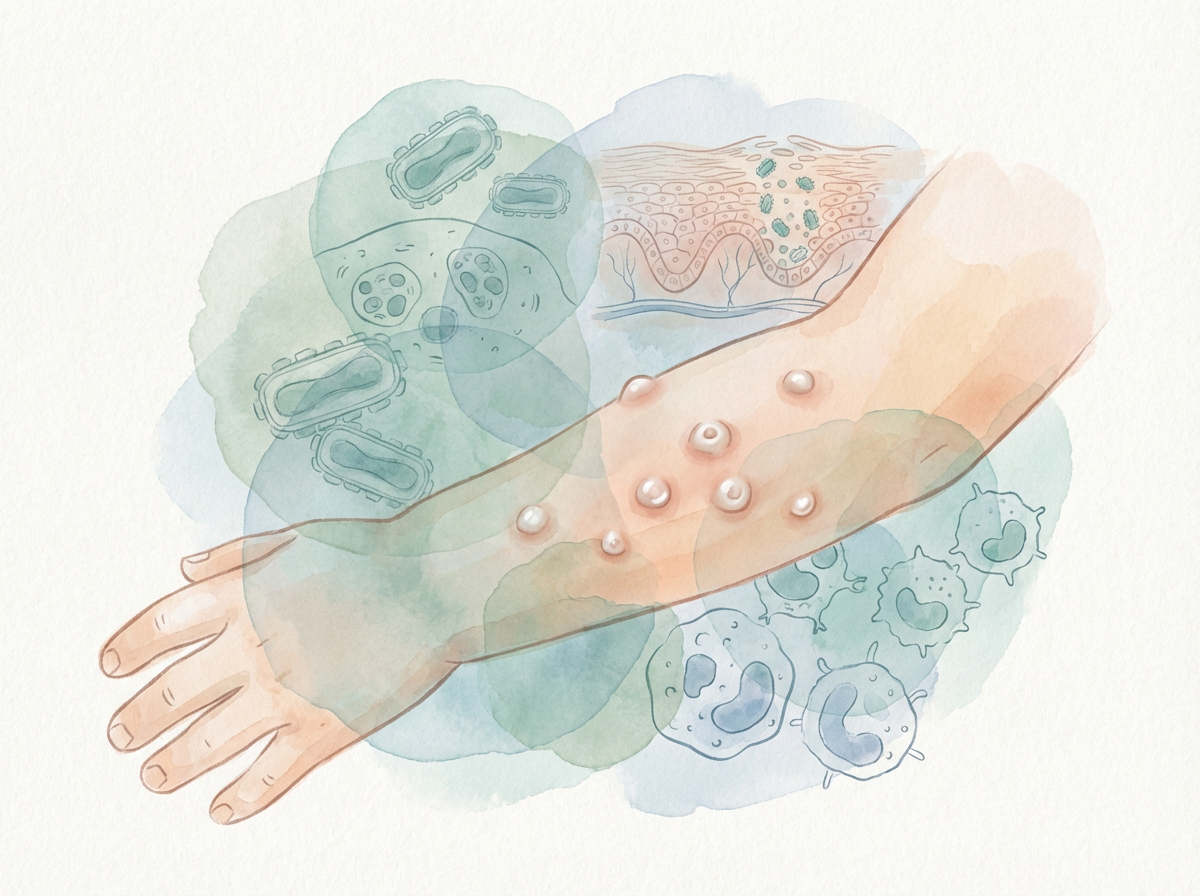
What Is Molluscum Contagiosum?
Molluscum contagiosum is a common viral skin infection caused by the molluscum contagiosum virus (MCV), a member of the poxvirus family. It produces small, round, painless bumps with a characteristic pearly appearance and central dimple.
The infection is highly contagious and spreads through direct skin-to-skin contact, shared towels or clothing, and self-inoculation (spreading from one area of the body to another by scratching). It is one of the most common viral skin infections in children.
While molluscum is self-limiting and will eventually resolve on its own (typically within 6 – 18 months), treatment is often recommended to prevent spread to others, reduce the total number of lesions, and avoid the social and emotional impact – particularly for children who may be excluded from activities.
Presentations we treat
Classic Molluscum (Children)
Small, flesh-colored or pearly, dome-shaped bumps with a characteristic central dimple (umbilication). Most common in children ages 1 – 10, typically appearing on the trunk, arms, legs, and face. Usually 2 – 5mm in diameter.
Adult Molluscum
In adults, molluscum can be sexually transmitted and often appears in the genital, lower abdominal, and inner thigh areas. Can also occur on the face, neck, and trunk through non-sexual skin-to-skin contact or autoinoculation.
Widespread Molluscum
Patients with eczema, immunosuppression, or HIV may develop hundreds of lesions that are larger, more persistent, and resistant to standard treatments. These cases require more aggressive management and monitoring.
Inflamed Molluscum (BOTE Reaction)
When the immune system begins to fight the virus, lesions can become red, swollen, and tender – the 'beginning of the end' (BOTE) reaction. While alarming, this is actually a positive sign that the body is clearing the infection.
How Molluscum Spreads
Understanding how molluscum contagiosum transmits is essential for effective treatment and preventing spread to family members, classmates, and partners.
Molluscum Contagiosum Virus (MCV)
A double-stranded DNA poxvirus that infects the epidermis. The virus replicates within skin cells, producing characteristic inclusion bodies (Henderson-Patterson bodies) that give the bumps their pearly, dome-shaped appearance with central umbilication.
Direct Skin Contact
The primary transmission route is skin-to-skin contact with an infected person. In children, this occurs during play, sports, and shared activities. In adults, sexual contact is a common transmission route for genital molluscum.
Fomite & Self-Spread
The virus can survive on surfaces and spread through shared towels, clothing, bath sponges, and pool equipment. Autoinoculation – spreading from one body area to another by scratching or touching lesions – is a major factor in lesion multiplication.
Compromised Skin Barrier
Children with eczema are particularly susceptible because their compromised skin barrier allows easier viral entry. Immunosuppressed individuals develop more extensive and persistent infections that are harder to treat.
How We Treat Molluscum at Our Marietta Practice
We resolve active lesions, prevent new ones from developing, and minimize the social and emotional impact – with a focus on gentle, child-friendly approaches.
Clinical Diagnosis
Your dermatologist confirms the diagnosis through clinical examination. Molluscum has a distinctive appearance – pearly, dome-shaped bumps with central umbilication – that is usually recognizable on sight. In atypical cases, dermoscopy or biopsy may be used to confirm the diagnosis and rule out other conditions.
Tailored Treatment Plan
Based on the number of lesions, their location, the patient's age, and pain tolerance, we select the most appropriate treatment approach. Options range from gentle topical therapies for young children to in-office procedures for faster resolution. We always prioritize comfort, especially for pediatric patients.
Spread Prevention & Follow-Up
We provide detailed guidance on preventing autoinoculation and transmission – including hygiene protocols, activity modifications, and skin care. Follow-up visits allow us to treat new lesions as they appear and confirm complete resolution.
Molluscum Treatment Options at Our Marietta Practice
Your treatment is tailored to the patient's age, number of lesions, pain tolerance, and how quickly you want resolution. We always prioritize comfort for children.
Cryotherapy
Controlled application of liquid nitrogen freezes and destroys individual molluscum lesions. Quick and effective for a moderate number of bumps. Brief stinging sensation during treatment with minimal downtime.
Curettage
Gentle scraping of molluscum bumps using a small curette instrument after numbing cream application. Provides immediate, definitive removal with excellent results. Particularly effective for larger or persistent lesions.
Topical Cantharidin (Beetle Juice)
A blistering agent applied in-office that causes the molluscum bumps to blister and resolve over 24 – 48 hours. Painless at the time of application, making it ideal for young children. Requires follow-up to assess response.
Topical Retinoids & Imiquimod
Prescription topical medications applied at home that stimulate the immune system to fight the virus or promote cell turnover to clear lesions. Slower but non-invasive approach suitable for widespread or recurrent molluscum.
Topical Potassium Hydroxide (KOH)
A solution applied at home that gradually dissolves the protein structure of molluscum bumps over several weeks. Well-tolerated and effective for children, with minimal pain compared to in-office procedures.
Watchful Waiting
Since molluscum is self-limiting, observation may be appropriate for patients with few lesions, no spread, and no social impact. We monitor for progression and intervene if the infection expands or causes distress.
Preventing Molluscum from Spreading
These steps are essential to prevent transmission and autoinoculation:
Avoid picking or squeezing bumps
Bandage bumps during activities
After touching affected areas
Towels, razors, bath sponges
Keep eczema-prone skin hydrated
Why Professional Diagnosis Matters
Molluscum vs. Warts
Warts (verrucae) are caused by HPV and have a rough, textured surface, while molluscum bumps are smooth, dome-shaped, and pearly with a central dimple. Treatment approaches differ – wart treatments can be too aggressive for molluscum and cause unnecessary scarring.
Molluscum vs. Other Skin Conditions
Molluscum can be confused with milia, closed comedones, flat warts, or even basal cell carcinoma in adults. In immunocompromised patients, cryptococcosis and histoplasmosis can mimic molluscum. Accurate diagnosis ensures appropriate treatment.
If your child has bumps that are spreading, or if you're an adult with new pearly bumps, a dermatologist evaluation provides an accurate diagnosis and the most effective treatment plan – often in a single visit.
What Our Patients Say
“Doctor Edward Chen is the BEST! He's very professional, very caring, he will always give you his honest advice. He helped my son who had acne issues – his skin now looks great like never before.”
“Dr. Candace Green has a very warm bedside manner and makes you feel very comfortable! Great office, staff, and overall experience.”
“The office is well run and Dr. Green is thorough.”
Molluscum Contagiosum FAQs
Answers to the questions our Marietta and East Cobb patients ask most about molluscum care.
No. Molluscum contagiosum is a benign viral infection that poses no serious health risk in healthy individuals. However, it is highly contagious and can spread to other parts of the body and to other people. In immunocompromised patients, it can be more extensive and persistent.
Dealing With Molluscum in Marietta or East Cobb?
Don't wait for it to spread. Our board-certified dermatologists offer gentle, effective treatment for molluscum contagiosum in children and adults – with multiple options to match your child's comfort level and your family's needs.
Most patients see significant improvement within 2 – 4 weeks of starting treatment.
Related Conditions & Services
Explore other viral and infectious skin conditions we treat at our Marietta practice